The elastic moduli express in mathematical form the ability of a material to temporarily deform under stress.
Hooke’s Law shows the relationship between stress and linear strain (usually represented by ε) through a constant which depends on the body under strain (σ = Eε). This constant is one of the elastic moduli, the Young’s Modulus (E), defined as the ratio of the stress σ along an axis on the deformation (ε) along the same axis:
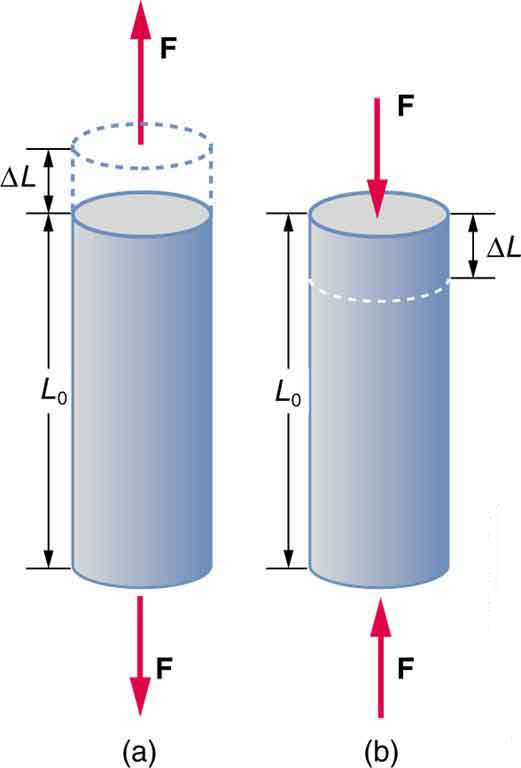
Young’s Modulus

Poisson’s Ratio (ν) is the radial strain to axial strain ratio (when a material is compressed along a direction it usually tends to expand in another direction):
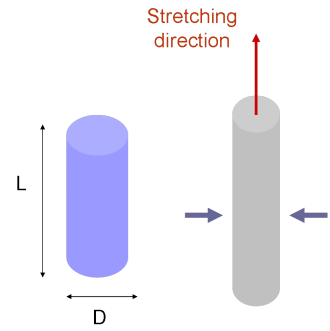
Poisson’s Ratio

The Rigidity Modulus (μ), or shear modulus, is the ratio between shear stress τand shear strain (it is also known as Lamé’s 2nd constant):
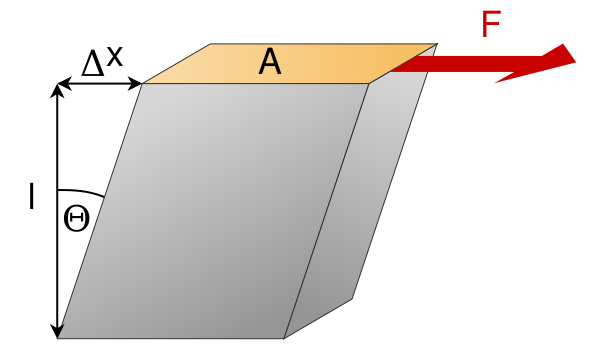
Rigidity Modulus

The Compressibility Modulus L (or Bulk Modulus) expresses the volume change following a deformation or strain:
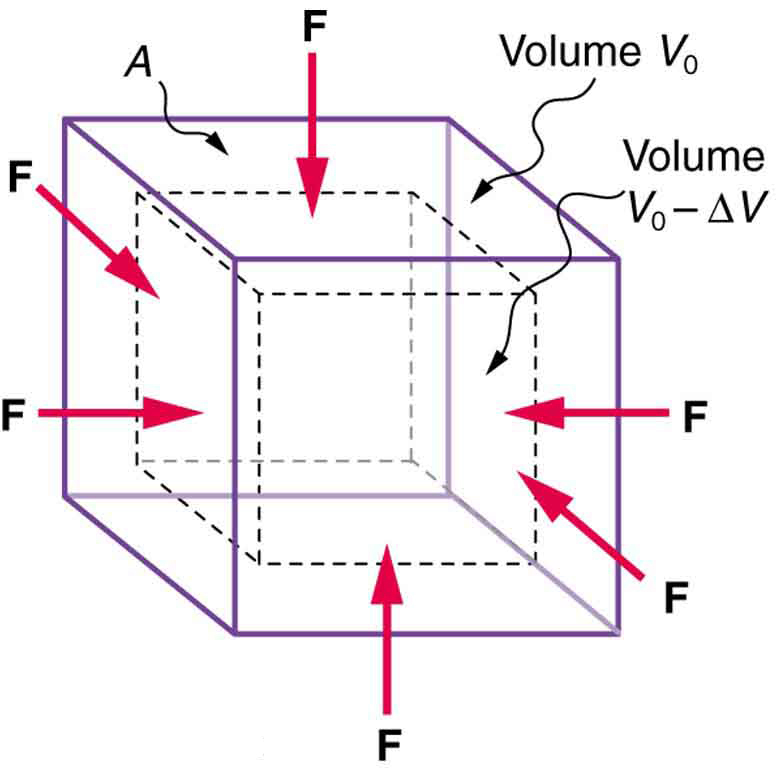
Compressibility Modulus

Lamé’s 1st constant λ relates the Bulk Modulus K with the shear modulus μ (Lamé’s 2nd constant):

hence:

| < Stress and strain | Types of strain > |