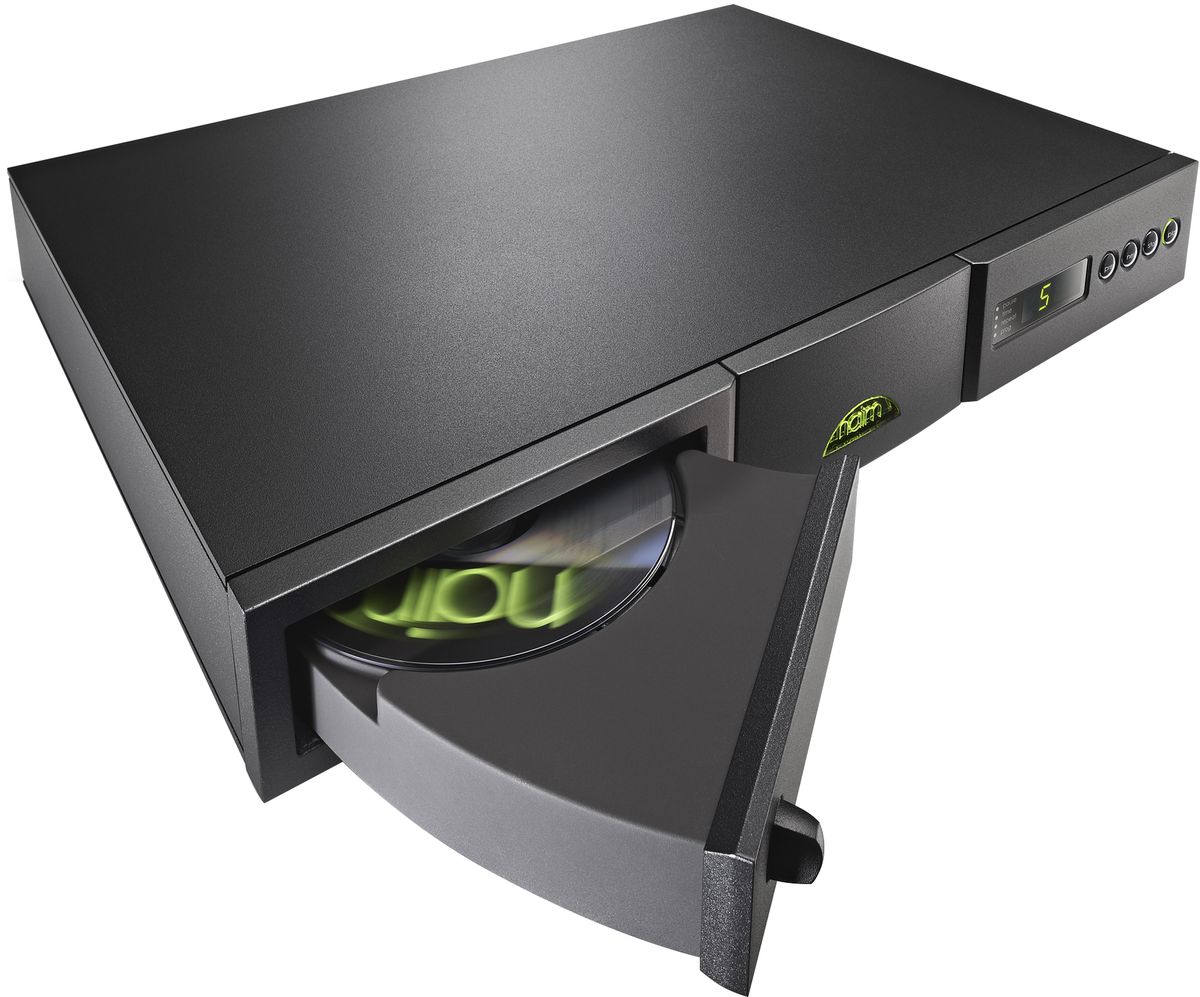
 The Compact Disc is a format that is becoming extinct. Streaming is the mode of the moment; for a few euros a month, we have all the music (or almost all) we could ever imagine. Just connect your computer or cell phone to a good DAC and you have a convenient and inexpensive digital source. If you have a good CD collection, the ideal solution is to extract the tracks onto your computer, catalog them, and listen to them whenever you want thanks to a good DAC (which some modern amplifiers also have built in). So what is the point of spending money on a CD player today? For those who appreciate having a physical medium, the CD remains a source that can sound really good. Prices are very low, even though CDs are actually coming back into fashion and could become more expensive. But there’s more…
The HiFi section of this web page is called I Still Play Vinyl, and the introduction also talks about how we were duped when CDs were proposed as a replacement for vinyl records as a purely commercial move, pushing us to replace our beloved 33s with the new sci-fi optical discs. Were they really that much better? There is much to discuss on this topic. The digital format has its problems, but so does the analog format! The point is that in the early days, turntable and phono preamplifier technology was very advanced, while CD player technology was in its infancy. You could certainly appreciate the absence of background noise, but the sound could seem cold and artificial. Meanwhile, technology has made enormous progress, and there is no comparison between what a modern CD player can do versus those of the early years. The point today is that recording and mastering must be done well. If so, the record sounds good on any medium, even streaming. Otherwise, no system can make it sound good; in fact, the better the system, the more it highlights the flaws in the recording.

The appeal of vinyl is undeniable, but from a technical standpoint, it is also undeniable that producing it involves infinitely greater complications than producing CDs.
That said, one could draw a lengthy comparison between the incredible hurdles that music must overcome when it is recorded analogically and, above all, mastered for vinyl, plus all the obstacles that the vinyl record playback system must overcome to finally reach our ears. If we think about it, it’s a miracle that vinyl sounds good (yet it does). In contrast, the simplicity of the digital chain is disarming in comparison. Streaming also has its problems, and if you want to include it in a true HiFi chain, you need to understand how best to configure a dedicated computer or purchase a quality streamer. The biggest problem for me is the Loudness War. For twenty years or more, there has been a sort of craze for compressing music tracks. This is probably done to make things sound better on a cell phone with earphones, which is the most common way of listening to music today. The result is that the dynamics (the difference between average and peak volumes) of a record are reduced to a minimum and the volume is turned up. This gives the impression that the music is more present, as if it were being blasted in your face, and at first glance you may like it or think it sounds better. But in reality, much of the potential sound quality is lost. The point is, who cares about these things anymore?

For years, music has been indiscriminately compressed, sold to us in remastered albums that are far worse than the originals—and streaming services serve us these remastered versions.
There are few of us boomers left who appreciate good music reproduction. So, streaming contains a huge volume of tracks remastered in this way. If I compare them with an old vinyl record from back then, these tracks are shamefully humiliated, and the difference is precisely the dynamic range. And consider that the thickness of the groove walls limits how deeply a signal can be engraved, thus limiting its dynamics. Dynamic range is measured in decibels of difference between peaks and average values. A vinyl record can reach up to 12 or 14 dB on a theoretical 70+. Meanwhile, the theoretical dynamic range available on a CD reaches 90 dB, a value that would make us start covering our ears. Today, a CD or streaming file can also have a DR7 or 8 (DR = Dynamic Range). So if I want to play music at its best on my HiFi system, which I have spent money and time on choosing components and upgrading over the years, I buy a fantastic DAC, connect it to my computer to listen to music at very high resolution (higher than that of a CD), but… with compressed dynamics?!
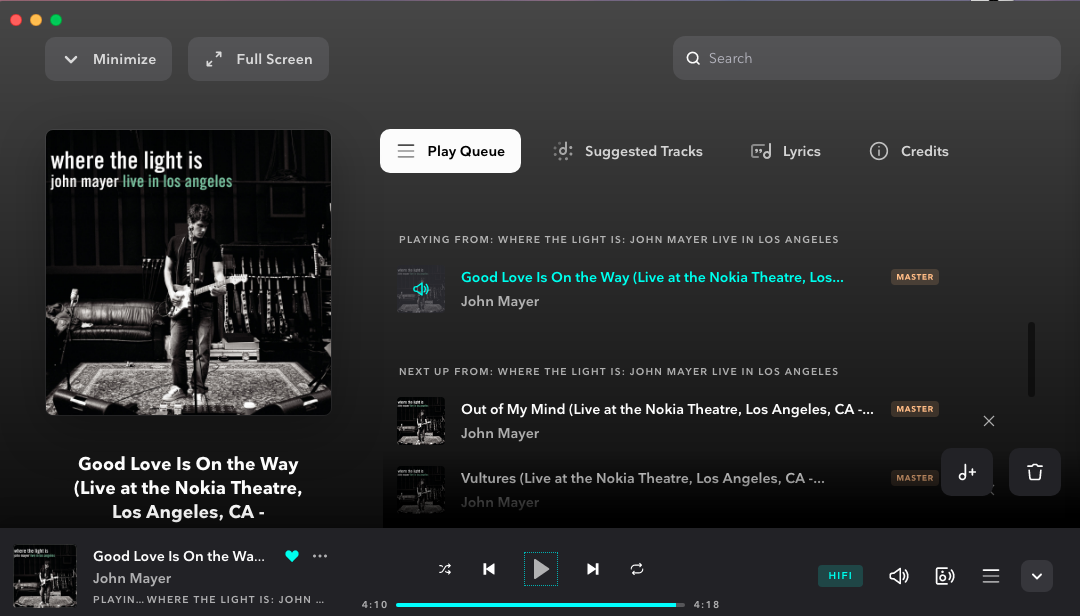
Online streaming can be a valid HiFi option if it is a service that offers at least 44100 Hz at 16 bits (the quality of a CD, which is the minimum requirement for it to be considered HiFi, but going beyond that is sometimes practically useless). However, it should be enjoyed with a HiFi system, from a computer connected to a good DAC or streamer, otherwise it is not worth the effort.
I use a streaming service anyway. Sometimes it’s nice to be able to listen to anything. It’s so easy to discover new music today, there’s no comparison with the past. And I like to listen to it at its best, even when it’s streaming. I chose Tidal because at the time it was the only one to offer CD-quality resolution at the base price. It also pays artists a little better per stream, after all, it was founded by artists. Today, it also offers higher resolutions than CD, but it’s not easy to hear the difference (partly because often there isn’t any; these are resamples of original recordings made with CD resolution anyway, and if the information isn’t there, you can’t add it). Normally, if I really like an album, I buy it, checking which is the best version by searching for information online. If it’s a CD, I first check its DR to make sure it’s not a remastered copy with the compression that’s so popular today.

The Rega Apollo CD MK1 (2004-2011) is still a valid product today. Rega began using Sanyo mechanisms when Philips stopped producing the ones used previously. They are still perfectly repairable today.
And for some time now, I’ve been increasingly choosing CDs simply because the price of vinyl records is ridiculous, while CDs cost a fraction of that—there’s no contest. So why not just listen to it via streaming? Because at the moment my streaming works with a computer connected to a DAC. I work on the computer all day and when I listen to music in my free time I don’t want to configure the computer for listening (yes, it’s not a computer dedicated solely to this and every time there’s a problem it makes me feel like I’m still working). A streaming device? The costs are disproportionate, given that the computer would do what they do better. It’s true that there are some good deals on recent used equipment, such as Cocktail Audio, which should be easy to use, and as I write, I’m starting to wonder why I’m thinking of spending money on a CD player!
But I’m a boomer (more or less) and I’m somewhat attached to the ritual of physical media. Streaming makes us rush, just like anything digital. The enormous choice is disorienting and after a while we end up choosing nothing at all and turning everything off (who hasn’t experienced this when choosing something to watch on TV?). And if we do choose something, the same enormous (and useful) availability pushes us to move on to something else, encouraging superficial consumption. The Long Playing (LP) record of old was conceived as a unique work of art, to be enjoyed in its entirety. And that’s what we did. When we finally got our hands on the much-desired record, we listened to it from start to finish. That’s what was there, and that’s what we listened to, over and over again. We didn’t have a million others to choose from. And we deepened our knowledge with each listen. Today, young people use the skip function constantly. After a few minutes, they move on to the next thing. In fact, young people are unable to maintain their attention for long. Even watching a whole movie has become problematic, and we too are losing the ability to do so. I still play vinyl for this reason too. To rediscover the slowness, the calm of deep immersion in the enjoyment of a musical work of art. And since it has become expensive, I can do it even if I still play poly (compact discs are made of polycarbonate, a type of plastic). The skip function is there too, but it is limited to an album, not a database with all the music in the world!
In addition, there is also the fact that with this subscription trend, we no longer own anything. If the internet goes down, we can no longer play music; if we don’t pay the subscription fee, we go from having everything to having nothing. It seems like blackmail. That said, as usual, the truth probably lies somewhere in the middle, in balance. We can continue to use streaming consciously and maintain our physical media collections, adding to them thanks to what we discover through streaming, which is also convenient for continuing to listen to music wherever we are.
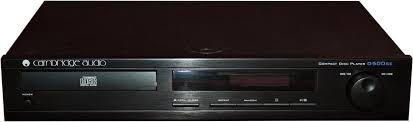
In 2000, the Cambridge Audio D500SE was a noteworthy player for mid-range systems. I only use it as a playback device, connected to an external DAC, but my system deserves better.
So, moving on to a more technical topic, what should I choose? I currently have an old Cambridge Audio player from 2000, which was quite remarkable in its day, but I bought it for €50 because the audio output wasn’t working. I use it connected to an external DAC and it works quite well. But it’s not up to par with my system. So if I want to go back to listening to my old CDs and, above all, buy new ones while taking advantage of the ridiculous prices (while they last), I could look for a worthy, prestigious player for my system. As I have often done, I turned to my favorite HiFi magazine, TNT-Audio. The editor, as always helpful and knowledgeable, favors an integrated solution with a dedicated CD player at this level. He advised me against pursuing my unfulfilled dream of owning a Meridian due to its advanced age and the risk of finding the mechanics ‘gone’ and facing additional repair costs. But in the meantime, I had been tempted by a good price for a Meridian 506.20 that I wanted to treat myself to for last Christmas. My enthusiasm upon its arrival was quickly dampened when the unit failed to read discs. Yet I had been warned! After returning the player to the owner and receiving a refund, I began to consider other options…

Christmas present to myself in 2025: a beautiful Meridian 506.20, the one of my dreams, which I unfortunately had to return because the mechanism no longer read discs and kept freezing.
With my budget, I can choose something interesting from the fairly recent used models of other notable brands such as Naim, Rega, or Cyrus. Rotel and Musical Fidelity also offer some good options. I have an excellent Naim Nait XS amplifier and wouldn’t mind pairing it with a player from Salisbury. But a Rega or Cyrus might also be right for me.
So I started researching, and there are a few things to consider. First, spending a lot of money on a CD player today is not really a good idea. Few manufacturers still offer CD players, even prestigious brands, and they often cost quite a bit. But they probably don’t invest as much as they used to in research and third-party components (partly because availability is lower than in the past). Today, the highly prestigious Naim only produces the CD 5si, which is not cheap and is the only one that receives official support. Previous Naim players, such as the CD 5i or 5i-2, were equipped with Philips CDM12.1 mechanisms with VM1201 lasers, which are no longer in production. There are compatible third-party copies that work well, but this is not always the case. The 5si uses a Sanyo FS-P101 mechanism, which is still on the market but incompatible with previous players. Rega also offers excellent players today, the new Apollo MK2 and its big brother Saturn MK3, the latter being much more expensive than the Naim (not to mention the top of the Isis series). Rega has been using Sanyo mechanisms since Philips stopped producing CDM12.1/VAM1201, starting with the first Apollo, which replaced the Planet in 2004. Rega’s first CD player caused a sensation and was a great success, but it used Sony mechanics, like my Cambridge (KSS 213), which is no longer in production and for which there are no compatible third-party copies. Cyrus now offers an excellent CDi player and a commemorative version of the Cyrus 40th anniversary, the CD40, which is even more expensive.

The Naim CD5i and the subsequently released 5i-2 feature Philips mechanisms that are no longer available and therefore cannot be repaired by the manufacturer; however, standard technical support services have no issue utilizing third-party replacement parts. Naim currently only produces the CD 5si, featuring the widely used Sanyo mechanisms.
I would like to find a model from one of these three manufacturers from a few years ago, without going too far back in time due to the aging of the mechanics and their availability. At the same time, I have to stay within budget. The first suitable player that comes to mind is a Naim. Used CD 5i or 5xs models (the higher-end model in the same series as my Nait XS) are easily found. Naim no longer offers service on these models, but the Italian distributor’s support team confirms that they have never had any problems repairing them with parts compatible with the old Philips mechanics that are no longer available. The CD 5i does not have digital outputs (but who would want to connect it to an external DAC unless they have a newer and more expensive Naim DAC?). The 5xs has a digital output and can also be upgraded by adding a Naim Flatcap or Hicap power supply at a later date, further improving its performance. Obviously, this is the more expensive of the two solutions.

Cyrus CD8SE + PSX: Cyrus players (not the CD6) can be upgraded by adding a Cyrus PSX external power supply at a later date. CD6 players can be upgraded to CD8, including the socket for these power supplies. They use Philips CDM 12.1 mechanics, which are no longer available, but the same applies to them as to Naim players (availability from third parties).
Rega has fewer problems with the availability of spare parts, as they were smart enough to adopt different mechanics at the right time. The two models of different ranks here are the Apollo and the Saturn. The Apollo and Saturn have more recent versions called Apollo-R and Saturn-R (the former is typically half the width of a standard HiFi component). The R versions should be improved compared to the previous ones. Today we are at version MK3 for Saturn and MK2 for Apollo. The characteristic feature of Rega players is top loading: no carriage, no CD slot, no motors or moving parts, you just lift the lid and place the CD inside. There are fewer parts that can break, but you need to position the player so that there is space above it to operate. Rega was very successful when it launched the Rega Planet, its first CD player, in the late 1990s, produced by a company famous for its turntables. The popular price of £995 was chosen specifically to make it the best player under £1000. The Apollo, which replaced it, also had the same ‘popular’ price. Over time, prices have fallen, but today a modern Apollo MK2 costs around £700. The fact is that the price of the old models was more of a challenge from Rega and did not necessarily represent their value from an audio point of view, even though its rivals Naim and Cyrus cost considerably more. Therefore, it may be a wise choice from an economic standpoint: lower prices but still high performance. And pairing Rega players with Naim amplifiers is quite typical: both favor pace, rhythm and timing (PRaT) and owe much of their fame to this. But Rega is said to offer a more “analog” presentation, with a wider soundstage without detracting too much from rhythm and precision.

Rotel currently produces the CD14 and its big brother, the CD1572, both in their MK2 versions. You can find good deals on used models, and they are excellent machines, but inferior to the various Naim, Rega, and Cyrus models mentioned above.
A few years ago, Cyrus offered the CD6 and CD8, which were subsequently improved with the S, SE, and SE2 versions, in which servo mechanisms were added to improve data correction during playback. The CD8 can be upgraded with an external PSX power supply, a bit like the Naim, but the CD6 cannot, which is why it costs less. It should be noted that Cyrus can upgrade the CD6 to CD8 specifications on request, including the option of external power supply. I wouldn’t mind a Cyrus CD8 + PSX combination. They too seem to be very detailed and accurate, so perhaps Rega would be better in my case. Yet, the current Cyrus CDi is highly rated.

The Marantz CD6007 and the superior CD60 have received excellent reviews from the specialist press. But even here, I doubt they can compare with the old Naim, Rega, and Cyrus models…
Something more recent is available under other brands such as Rotel, for example: the CD1572 has received excellent reviews. The cheaper CD14 and CD11 versions are not bad either. There is a lot of praise (so much so that it seems to be the most hyped by the press) for the Marantz CD6007 and its top-of-the-range version, the CD60. Arcam, famous in the 90s for its Alpha series players, is also back in the game with an excellent CD5, which I have read very good reviews about, but it is too early to find used ones. Of course, there is complete peace of mind regarding mechanical operation here, but they are all a step below the Naim, Rega, and Cyrus players mentioned, particularly in terms of their modern, bright sound. High-end CD players that are not too old have better tonal balance and overall performance.

Arcam has returned to producing CD players with this excellent CD5 Radia. The reviews are very positive, but doubts remain in a possible comparison with the great CDs of the recent past.
So what to do? Consider that CD players of the same level sound very similar. Though it is said that the Naim is more responsive and precise, the Rega is more dynamic and engaging, and the Cyrus is more detailed and solid, it all comes down to price considerations and the possibility of trying them out. As I’m writing,, I can see a Naim CD 5i-2 for $450 within driving distance or a Naim 5xs for $600 plus shipping; a Rega Apollo for $400 within driving distance or an Apollo-R for $400 plus shipping. From Cyrus, I can see a CD8 and a CD6s, both with new lasers and warranties, but at $690 and $680 plus shipping respectively. The SE versions are much more expensive, not to mention a used CDi! And we’re already over budget. Rega is the most affordable and, given my previous experience with the faulty Meridian, I would prefer something I can go and try out and take home myself. So that leaves the Naim CD 5i-2 and the Rega Apollo MK1, which would win out due to its lower price and the fact that Sanyo mechanisms are easier to repair than Philips ones…
———————————-
Update: enter my “new” 2006 Rega Apollo CD Player