 The HiFi section of this site is called I Still Play Vinyl. But “vinyls”, turntables, tonearms and cartridges have now reached such absurd prices that it has become uneconomical. Perhaps I should update the title (or add to it) with I Still Play Poly(carbonate).
For a long time, the Compact Disc, a format considered almost dead, experienced a decline in sales and consequently in prices, making optical discs a good deal again! And I remember well when people complained about the price of CDs! Now they are coming back into fashion and prices will surely rise again.
Even the CD players of the past, which used to be ‘tossed at you’, have reached price levels that make you laugh bitterly. For example, I remember for example the old Sony CD77ES, a high-end CD player from the 1980s, which a few years ago you could buy for a few dozen euros, and now they cost as much as 800!
It’s market madness, okay, but the obscene prices of all things analog (therefore, cool) have rekindled my interest in CDs. And in files…
Some time ago, I chose Tidal as my streaming service because it offered uncompressed music at the same basic price as the others. I am someone who likes to have physical media; playing files does not appeal to me, partly because I work with software and in my free time I do not want to have anything to do with computers. The prices of my preferred format prevented me from buying it: if I want an album that costs me 60 euros on vinyl and 10 on polycarbonate (CD), it’s a no brainer. Do I even think about it? At one point, I even thought about giving up all physical media and using only streaming: 10 euros a month and you have all the music that exists. It might be the rational choice, but I don’t have the courage…

Schiit Modius D/A converter
So I started thinking about what I could do to improve the digital section of my system. Where are we at? The DAC was an inexpensive ProJect DACBox E. To read CDs, I used an old Cambridge Audio D500SE as the reading mechanism. For Tidal, I have an old MacBook that I connect to the DAC via Toslink (the Mac’s audio output is also optical, you just need a minijack-Toslink adapter). But Apple no longer allows me to update the operating system and I can no longer install the Tidal app; I would be forced to use it via a browser, losing the possibility of exclusive use and other amenities that improve playback.
As things stand, a good vinyl record on my system sounds much better than the equivalent title streamed (especially for recent productions, which are suffering from the loudness war).
The first thing that came to mind was to upgrade the DAC. In particular, the ProJect does not have a USB input, which could have improved the quality of streaming from a computer.
I wasn’t convinced by the CD player: I bought it for 50 euros because the analogue output didn’t work. I was only going to use it as a transport anyway. But some problems with the tray jamming led me to tinker with it, replace the belt with a better one, etc… I didn’t trust my abilities, so I remained with the impression that something was missing…
Then I came across an old Pioneer PD S603 from the 90s, one of those with the reverse mechanism (the CD is inserted face up), with a remote control and lots of buttons and lights. You know what? I only need it as a transport, I like the 90s look, it’s been serviced and it seems astonishingly new – 110 euros? I’ll take it.
But the digital output is only optical. Oh well, no big deal!
Well, actually…

Pioneer PD-S603 “Stable Platter” CD Player of 1995-6
The comparison between the Cambridge via SPDIF and the Pioneer via Toslink on the Project DAC resulted in the Pioneer winning. What I really didn’t expect was that the Pioneer would sound better from its analogue outputs than the Cambridge connected to the Project DAC! OK, so the DAC is the weak point!
I came across an advert for a modern Schiit Modius DAC, which had impressed me with its excellent reviews and affordable price. For 120 euros, it replaced the heart of my digital section.
What upset me was that I still couldn’t hear much difference between the Pioneer’s analogue outputs and the sound reproduced by the DAC when the Pioneer was connected via Toslink (even if I reversed the RCA cables between the player and the DAC). Am I tone deaf? Okay, I know that differences in digital are only nuances, but come on, the Pioneer’s internal DAC is from 1995! The Schiit Modius is only a few years old!
Then I had an idea: I took the Cambridge out of the closet and connected it to the SPDIF input on the Modius. It sounds better than the Pioneer! What’s going on?
I understood this when I made the comparison using the Cambridge’s Toslink digital output: it sounded practically the same as the Pioneer connected with its toslink output. The difference I heard was between the two different connections, toslink and spdif. I had read that toslink is inferior, more problematic, especially in managing jitter (yes, these are nuances, but this time I can hear them). In addition, the Cambridge has a BNC connector, not RCA, which is also better than the latter. Probably the level of the ProJect DAC’s SPDIF input was such that I couldn’t hear a better sound than the Pioneer’s analogue output, while the Modius’s excellent jitter management of the SPDIF input enhances the Cambridge’s capabilities as a reader.
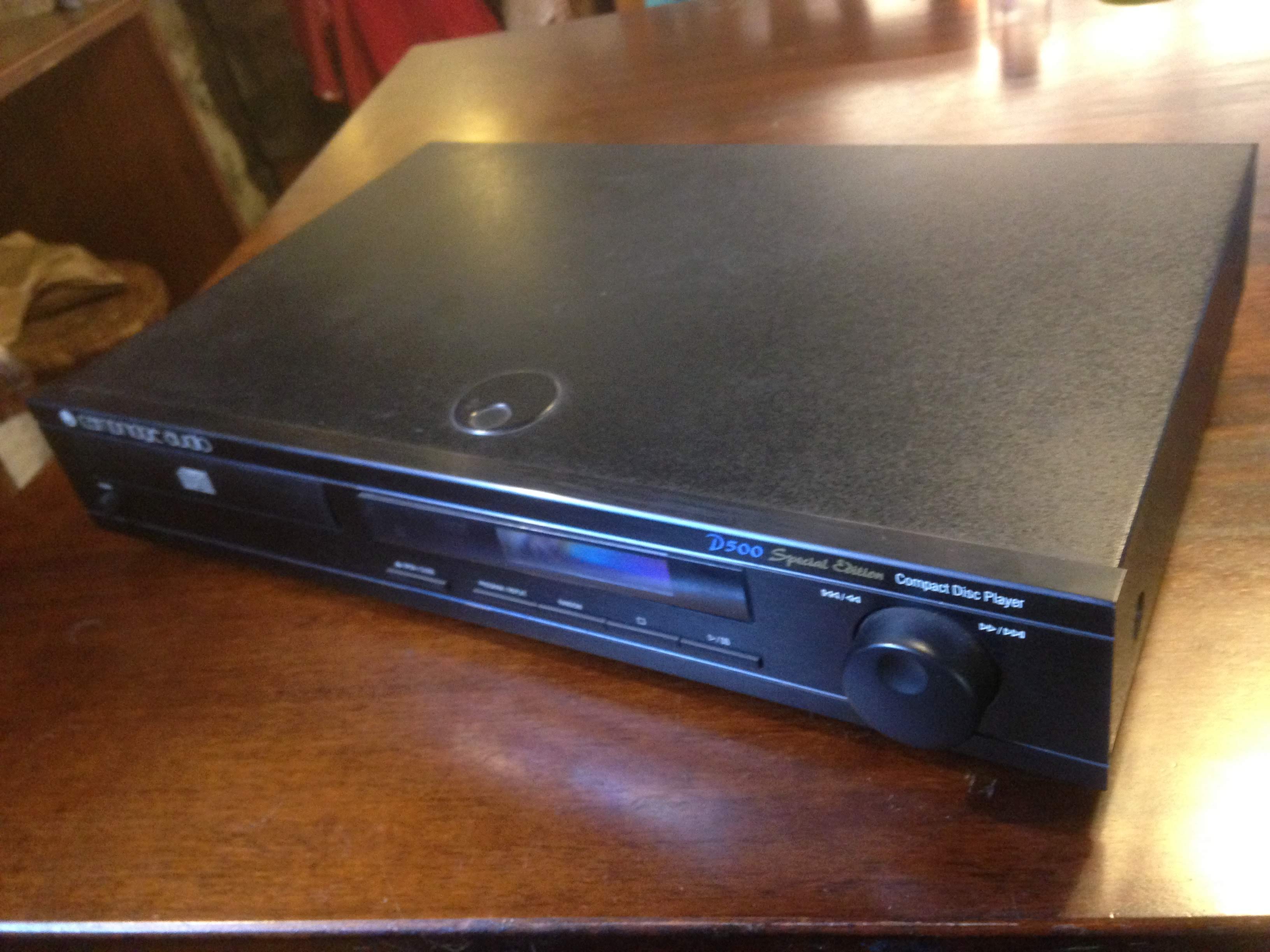
Cambridge Audio D50SE CD Player of the 2000’s
So I bought an excellent 75 ohm (ideal for digital connections) BNC-RCA cable for the resurrected Cambridge (I also got him a remote control, which he was missing). A technician checked the laser alignment and it seems to be fine. I still need to clean the lens and maybe put some anti-vibration adhesive sheet inside the metal chassis.
And now my system also has a digital section that is up the job.
And what about files?
I had to solve the problem with the Tidal app on an old Mac. I purchased Audinirvana Studio (6 euros per month): it is a system that manages your computer’s audio playback, including your streaming subscriptions. You can specify the folder where your files are located and play them through Audinirvana. Everything can be conveniently managed through the free app that turns your smartphone into a remote control. I had ripped my gold Mobile Fidelity Original Master Recording CDs before selling them, as I had started playing vinyl records again. I also have some of my own recordings, which are a pleasure to listen to in such high quality.
The fact remains that streaming is frustrating because of the enormous choice available. The same thing happens with television: if you have to choose a film or series to watch in the evening, you end up going to bed exhausted from searching and not watching anything. It’s no different with music. Of course, it’s useful for listening to music before deciding to buy a certain album, but you can also do that for free on YouTube or in other ways… I’m not sure how convenient it is to pay for high-fidelity trials. Between Tidal and Audinirvana, I spend more than £200 a year on high-fidelity streaming on my stereo system. That makes me want to cancel everything and invest £200 a year in records (that would be an average of 10 LPs or 20 or more CDs). If they didn’t cost a fortune, I’d be tempted to make cassettes tapes from YouTube videos, recording the stream from my computer through the DAC.
Streaming has taken music out of our hands; we no longer own anything, it’s all subscription-based. We allow ourselves to be persuaded by convenience, by the reduction in clutter, by the practicality of having everything at our fingertips on our smartphones. But are we really better off this way? The enormous availability only makes the enjoyment extremely superficial. When you bought a record, whether vinyl or polycarbonate, you would listen to it in its entirety for several days, at home or in the car (or while walking for those who had a portable player). The digital world, on the other hand, keeps us rushing around; there’s no time to finish listening to an album. In the past, people would get to know each record in depth and, by buying it, directly supported the artist with the proceeds from sales. With subscriptions, artists earn very little. If you are a star, you still earn very well for other reasons. But “average” musicians are at risk of disappearing, like the middle class, which is struggling more and more. Wealth is increasingly concentrated at the top and in the hands of a few.
If the internet goes down, we can still listen to records. We have algorithms that recommend music to us by analysing our previous choices. Is this really better? In my opinion, music streaming adds to the enormous noise of all kinds of information that we are constantly bombarded with every day. All algorithms want our attention, they do everything they can to keep us on a given platform, taking time away from our lives. We all fall for it, myself included as I write this; it’s not easy, these systems are extremely powerful. We no longer delve into anything because there is too much information and it is designed to be consumed quickly, and therefore superficially.