 That is the question!
My love-hate relationship with the famous green pedal…
It took me a while to appreciate it, but I finally got there. That’s normal—there are legions of fans and critics of the Tube Screamer, the iconic pedal created by Ibanez in 1979 and made famous by countless professionals and guitar stars. Like most guitar effects, its effectiveness depends (heavily) on the amplifier. A pedal like the Tube Screamer can sound amazing on some amps and terrible on others. And that can be misleading, making you think the pedal is the problem. Instead, it’s all about pairing. In fact, in my ignorance, I initially found myself among the detractors, but then something changed…
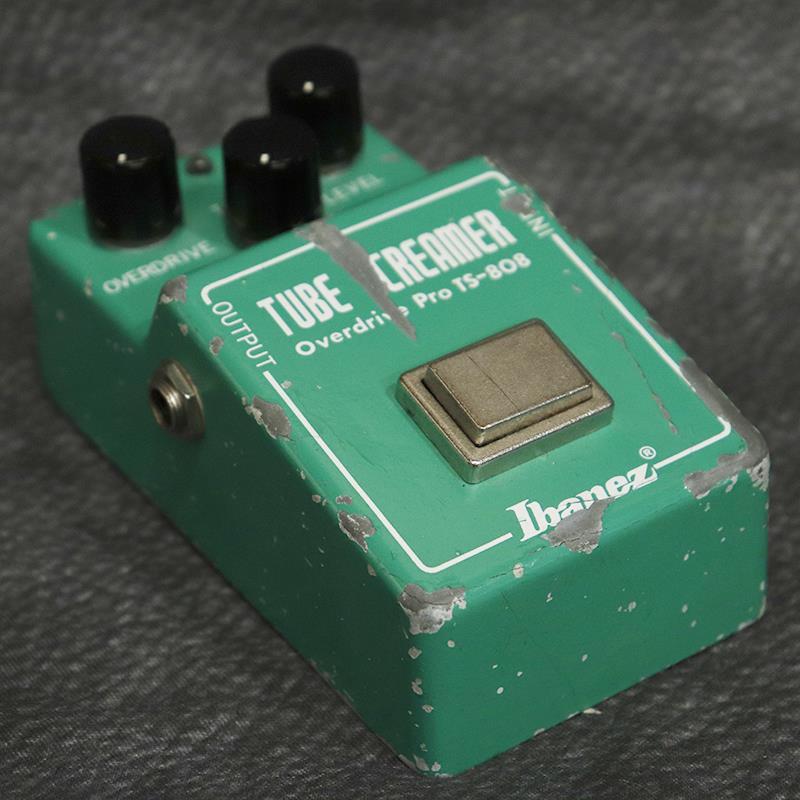
The Ibanez Tubescreamer is a symmetrical soft-clipping overdrive circuit. Its history is described in detail by the excellent Mike Piera, aka Analogman, a great enthusiast and expert (as well as a skilled modifier) of the Tubescreamer and many other pedals. This circuit was designed by Japanese engineer Susumu Tamura for Maxon as an alternative to the Boss OD-1, with the aim of both replicating the warm overdrive of tubes in progressive saturation and pushing them to their optimal saturation point. The effect of saturated tubes is to smooth out the peaks of the signal they amplify (clipping). Tubes tend to create asymmetric clipping of the wave peaks (the cut is different on both sides of the wave), generating even harmonics; the Tubescreamer performs symmetrical clipping (Boss held the rights to solid-state asymmetrical clipping, so Tamura had to opt for the other method), generating odd harmonics: it seems that the combination of these harmonics sounds good to the human ear.
While demonstrating the prototype at the famous Sam Ash music store in New York, Tamura recounts that the founder’s grandson said, “It sounds like a screaming tube amp”—and this gave the effect its name. Since Maxon held the license to sell only in Japan, the effect was distributed overseas as the Ibanez TS-808 Tubescreamer Pro Overdrive. It is the most copied circuit in the guitar pedal effects industry. There are countless clones or versions, with different circuits but all sounding the same. And the goal is now a classic one: to boost the midrange frequencies characteristic of the electric guitar by attenuating the low end and rounding out the high end, allowing the guitar’s sound to stand out.
My first serious overdrive pedal was a Fulltone OCD. It’s very different in design: it uses hard clipping like a distortion pedal, with MOSFETs and diodes to achieve it, whereas the Tubescreamer is based on an op-amp made famous by that pedal. The person who introduced me to the splendid OCD told me it has a nice, transparent sound: it doesn’t alter the frequency response of the guitar signal, unlike the Tubescreamer, which does so intentionally. The sound is therefore beautiful but doesn’t “stand out” easily from the band’s mix. The ideal setup would have been to pair it with a “mid-boosting” pedal like the Tubescreamer. Incidentally, my friend didn’t even like the Tubescreamer and didn’t use it.

My first Tubescreamer circuit: Electro-Harmonix East River Drive (sounds exactly like a TS-808; components personally recommended by Mike Piera—Analogman)
But he got me thinking, and I started doing some research. I ended up, of course, on the Analogman website and read all the information. The “vintage” TS-808 Tubescreamers produced from 1979 to 1986 now go for outrageous prices, even as high as 1,000 euros. It’s utter madness. From 1981 to 1985, Ibanez had launched the successor model, the TS-9, made famous by none other than Stevie Ray Vaughan. These were also brought back into production in the 1990s. Since 2004, due to popular demand, Ibanez has resumed production of the TS-808 in Japan. Mike Piera modifies the “reissue” pedals specifically to bring them closer to the original specifications, particularly if they use a chip other than the famous JRC4885D. His expertise is universally recognized, so much so that Electro Harmonix had asked him for advice on the parts to use in a Tubescreamer circuit. From that advice came their East River Drive, which is affordable and sounds great. And it was the first Tubescreamer I ever bought. And I really liked it!
So much so that I thought about treating myself to a real Ibanez, or at the very least a Maxon (which was the company that used to build Tubescreamers for Ibanez). I wrote to Mike Piera for advice, and he simply told me to get any one that was well-built and could be modified if I ever felt like it: “Get one BUILT WELL, not a disposable pedal made with SMT parts and everything on the board…”.

A version of my pedalboard with the TS-9 boosting the OCD
I ended up buying a TS-9 at a good price. And it was a disappointment: I had recently bought my first tube amp, and it had a crystal-clear sound. I was starting to pick up on the nuances of the tones, and when I plugged in the TS-9, I didn’t like it very much. I was puzzled. Maybe the TS-808 sounds closer to my taste? The TS-9 was so nasal that it almost bothered me. In the end, I sold it. What makes me think is that the buyer complained that he didn’t recognize in that pedal the sound he appreciated in the TS-9. I told him that I, too, was disappointed and was selling it for that reason: I had come to terms with the fact that I wasn’t a fan of the Tubescreamer. But rereading the Analogman website, I see that there are some TS-9 editions that sound bad, which he successfully works on to restore them to their original quality. Usually, these are the ones that use the Toshiba TA75558 chip, and there are several of them among the reissues. Maybe I just happened to get one of those…
My doubts had resurfaced. But I also wondered if I might be one of those people who, when using an overdrive as a mid-range boost, prefers a Klon to a Tubescreamer? I gave it a try: a genuine Klon is worse than a vintage Tubescreamer, and it costs several thousand euros. I looked through the clones and chose the Way Huge Conspiracy Theory. I liked it and used it for a while to boost the OCD. Then, influenced by the very nice Mike and Dan from That Pedal Show, I saw that it worked well at the OCD’s output, giving the sound a sort of “straightening” effect. And what was in their pedalboard before the OCD? A Tubescreamer: the ideal pedal for boosting an OCD. Really? I wanted to give it a try by going back to the TS-808 circuit. I got a Tubescreamer Mini so I wouldn’t risk spending too much. The circuit is absolutely identical to the standard version, but it’s true-bypass instead of buffered and can’t be battery-powered. Not bad! So maybe I like the TS-808 and not the TS-9? Yet they’re identical; the TS-808 just has a slightly different output stage and a different input impedance. But it can affect the sound, and maybe that’s the point. The fact is, I still have the Mini. I ended up selling the Klon clone.
Thanks again to the guys at That Pedal Show, I finally realized that an overdrive pedal needs to be paired with the right amplifier. The Tubescreamer is designed to boost the midrange frequencies. Amplifiers like the Fenders that SRV used typically lack midrange and emphasize the bass and treble. The Tubescreamer complements them wonderfully, as I discovered when I happened to use one in the rehearsal room. If you pair it with an amp that also boosts the mids, like a Vox, the result is too much—it’s unpleasant. Guess what kind of amp my Bugera V22 is? It uses EL84 power tubes, just like the Vox. It’s not the right platform to work with the Tubescreamer. But neither with the Klon. The OCD works great, actually. One solution is to use the Bugera’s tone knobs to cut the mids and boost the highs and lows. An equalizer can do a lot to tone down the Vox character of the Bugera and bring it closer to a Fender (actually, the Bugera’s clean tone is excellent and crystal clear, a cross between Vox and Fender; in any case, it’s a great platform for pedals, so with a few tweaks, I’m good to go).

A pedalboard that winks at John Mayer with the Klon, Blues Driver… and a TS-808 boosting the OCD
A while later, I got involved in a John Mayer Trio cover project. And what does John Mayer use? As a big fan of Stevie Ray, he goes for Fender amps or similar models (Two Rock and Dumble) paired with a Stratocaster and a Tubescreamer—it’s the perfect setup! In the meantime, I had bought an excellent Italian overdrive pedal, the Masotti OD Box, which has a switch to change the type of clipping. One of the settings, called “vintage,” sounds like a Tubescreamer. For a while, I couldn’t decide between the TS-808 and the vintage setting on the Masotti, which is excellent in its own right. But in the end, the TS-808’s sound is distinctive; it has its own unique and recognizable tone. So, as a guitarist now involved in the John Mayer project, I decided I had to have a real TS-808!
And then I had a digital crisis. I realized I’d spent a small fortune on pedals by that point. It seemed absurd to me. Plus, lugging the pedalboard around to rehearsals was a huge hassle. So I did something crazy: I sold everything (well, almost everything) and bought a digital effects processor—the Line 6 HX Stomp! Great machine. I was a geologist, but now I’m a computer guy. All day long with software, programming and troubleshooting. What am I doing, the same thing with music in my free time? No way. It lasted a week and I sold it. But by then the damage was done. Several pedals were gone, including the TS-808 (though I still had the Mini). I bought a few things back. I reconsidered using a Klon clone as my main overdrive, since I was more focused on the John Mayer project than anything else. So much so that I switched from a J. Rockett Archer Silver to an Archer Ikon. But when used in a chain with the TS-808 Mini, it all sounded too nasal to me. I then went back to a Way Huge Conspiracy Theory, which I had fond memories of—less nasal and more transparent than the others. Better. But in the end, I prefer the Blues Driver as my main overdrive, boosting a Tubescreamer for Mayer-style tones. And the usual TS boosting an OCD for other things. I like the Conspiracy Theory, and rather than give it away, I use it as a boost at the beginning of the chain. When needed, I can turn up the gain a bit, which is similar to how JM uses the Keeley Katana—a clean boost that has a switch to add a slight overdrive.
But the issue is always the same: if the amp doesn’t pair well with overdrives, the sound isn’t great. That’s where a special pedal comes in—a digital multi-effects unit I’ve had for a while that actually serves a purpose: the Zoom Multistomp may not have the quality of an HX Stomp, but its modulation effects aren’t bad. Ultimately, it’s a Swiss Army knife that comes to your rescue when needed. And if necessary, it also has some decent amp sims—nothing special, but they work. I use them to go straight into the mixer when needed, but then I discovered they’re actually pretty good for recording too. While recording Mayer tracks on his Two Rock amp sim, I discovered that playing the TS-808 Mini is a real pleasure—it feels smooth under your fingers, with an iconic, instantly recognizable sound. That’s why people love it. With the right amp, it’s legendary! I was finally sold. And I would have liked to have a more substantial pedal to do the Mini’s job. There are tons of excellent interpretations out there. In Italy, Cornerstone has the Antique, which is of exceptional quality; it sounds just like a Mayer-style Tubescreamer even though it isn’t a Tubescreamer circuit. Even the iconic Boss DS-1 Super Overdrive isn’t the same circuit but sounds almost the same (though it has asymmetric clipping). The JHS Bonsai includes every Tubescreamer version ever made and works great, but it costs even more than the Antique (and I’m no longer into boutique pedals). I thought back to Mike Piera’s words and set out on a search.
I don’t have the ideal tube amp; the V22 is a Vox-Fender hybrid in terms of sound, but it’ll do. I should get a real Fender, but for now, this will have to suffice. For now, I’ve picked up a real TS-808, again. As a new fan of the Tubescreamer—which John Mayer’s Trio uses—it’s almost a must-have, if only because it’s iconic for a certain type of music and for the history of blues rock.
And so the valves will start screaming again…