At the end of 2025, I was looking for a more suitable CD player for my system. Turning to TNT-Audio for advice as usual, I was given a list of magical names, including Naim, Rega and Cyrus. These echoed in my memory from when I decided to buy the speakers I still have today, the TDL Studio 0.5. I was told that they needed to be driven by amplifiers of a certain standard, such as those from the three British brands mentioned above. While I was gathering information, it occurred to me to consider a return to Naim: I had the Nait 5i and then, overcome by nostalgia for the Unison Research Mood with which I initially drove the TDLs, I indulged myself by buying an Unico. For a while, I compared it with the Nait 5i and it seemed to me that although the latter was perhaps more consistent in terms of tone, more detailed and precise, it had more difficulty driving the TDLs at low frequencies. So I kept the Unison, but I was left with the doubt that a superior Naim Nait could have done the same job.

Naim Nait XS of 2012
So I said to myself, why not get a Nait 5si and see if it works better? After all, it will be easy to resell one of the two and make a virtually cost-free transaction, a bit like putting money aside by investing it in prestigious HiFi components.
On paper, the Nait 5si seemed to be a good fit. 60 watts with good current delivery. My doubts were the apparently superior build quality of the Unico and the supposed lack of three-dimensionality in the Naim’s soundstage.
For example, the outputs for connecting the speakers to the Nait are simple banana plugs inside the chassis, with nothing sticking out. The Unico has generous gold-plated terminals protected by transparent plastic, which are also suitable for banana plugs. It looks much better and is certainly more pleasing to the eye. But Naim’s motivation is guided by the principle of essentiality and rationality: with banana plug sockets inside the chassis, there is nothing outside that can break or cause accidental short circuits. In Naim’s purely engineering approach, there is no need to provide large gold-plated terminals to ensure excellent contact. They saw that banana plugs provided what was needed, so that’s what they supply. That’s it. The shorter the circuit and the shorter the signal path, the better the end result, so no frills, just the essentials. They patented a new PCB bayonet mounting tachnique so that the board is elastically suspended from the chassis in order to minimize microphonic effects due to vibrations. However, there are no compromises when it comes to the quality of the components. It is the same philosophy that leads them to prefer DIN connections to RCA ones, so much so that the first models did not have RCA connections at all. Today, Nait offers both. Otherwise, to connect other brands of electronics, you had to buy DIN-RCA cables, which are not cheap if they are Naim branded…

The Nait XS has plenty of both RCA and DIN inputs
Designers even leave the screws that secure the DIN and RCA connectors to the chassis slightly loose, because they have found that if everything is tightened too much, it promotes current leakage, which is best to avoid. Even the IEC socket is floating so that it won’t transmit external vibration via the mains cable! In short, while some dazzle you with gold-plated connections, others stick to the essentials and focus on what matters most.
Reconsidering these aspects, a little voice told me, ‘How nice it would be to have a Naim amplifier and a Rega or Cyrus CD player…’ when in reality a Naim player would be better, in perfect synergy with a Nait. But reason has little to do with this discussion. I am more influenced by the memory of my youth dream, when I looked forward to making comparative listening tests with the Naim Nait 1 of the time, the Mission Cyrus 1 or a Musical Fidelity, Arcam and Audiolab to see which one would best drive the hard-to-drive TDLs. Unfortunately, this didn’t happen because the place where I found the TDLs didn’t have those amplifiers, perhaps only a Musical Fidelity, but I don’t remember clearly. However, they did have a Unison Research Mood, which I liked very much.

The Nait XS impresses at first glance as a high-quality component.
So, while searching for the right CD player, I started looking for affordable Naim Nait amplifiers. It had to be comparable in price to the used Unico, something that would allow me to break even on the operation (effectively an emotional sidegrade, justifiable only at low cost). And so I would finally be able to compare amplifiers for driving my TDLs.
The Nait 5i-2 (the ones with the italicised i) were reasonably priced but did not seem to offer a significant improvement. To get something more, I had to go for at least the Nait 5si. A few units were available at a reasonable price. However, I still had some doubts about their ability to deliver sufficient peak current for the demanding load of the TDLs. From a mathematical point of view, there’s no question about it: if the Studio 0.5 delivers 86 dB at 1 metre with a single watt, which becomes 83 at a more realistic distance of 2 metres, and 86 again if we consider two speakers, well… we’re already at a very high volume! Let’s talk about peak: the Nait 5si is rated at 95 watts peak into 8 ohms. With 6 ohms, it should rise to about 100 dB. Is that enough?
More than enough. And much more so in an XS, which is more refined in construction, with Supernait technology (the top of the Naim integrated range) scaled down to a more affordable model. In short, a 60W XS, thanks to its 380VA toroidal transformer, still delivers superior performance to a 5si. So I focused my search on this model, the first version from the early 2000s. I then stumbled across an inviting advertisement. The serial number indicated a production date of 2012. In fact, the XS-1 series had undergone a restyling in the early 2010s, retaining the name Nait XS on the back of the chassis, while the box said XS 2. But they had changed little or nothing in the circuitry, though they had aligned the style of the front panel with the Nait production of the time.
So, in the last few days of 2025, I put another Naim Nait under the Christmas tree. The intention was to compare it with the Unico and then decide which one to resell.
When I tested them side by side during the couple of days I still had the Unico (which I quickly sold for the same price I paid for the Naim), the two amplifiers were very similar in performance, and I could easily have lived with either one. Like the 5i I owned previously, it seems to have a little more definition in the high range than the Unico. The latter surpassed the 5i in low-frequency drive, but the XS is there, on a par if not sometimes more defined even in this part of the spectrum. In short, while the 5i may have been slightly inferior to the Unison, the Nait XS is not embarrassed by the difficult load of the TDLs and sounds wonderful…

Two fantastic integrated amplifiers. In the end, I opted for the Naim, but I could have lived with either one.
In the end, I decided to keep the Naim. The Unico had been my return to Unison Research after the glorious Mood. I was left with the suspicion that a higher-end Naim could drive the TDLs as smoothly as the Unico. I satisfied my curiosity and the XS was my return to Naim…
The slightly superior ergonomics (the switch between sources can be operated by remote control instead of a knob), the solid, completely enclosed construction (the Unico has slits in the upper part of the chassis, which was not ideal in my dusty home with cats) and, last but not least, the prestige of a historic brand made me lean towards the British model.
In the future? Well, another point in favour of the Nait is the possibility of upgrading it by connecting it to a dedicated external power supply such as a Naim Flatcap or, better still, a Hicap.
Actually, some class-D power amplifiers with an astonishing price/quality ratio, the ZeroZone IRS2092, have recently appeared on the market. At the unbelievable price of around 300 euros per pair, the little Chinese big boys promise to outperform much more renowned competitors! Their fame is spreading like wildfire and it seems that even the end section of a Supernait is no match for them! Maybe one day I’ll get a prestigious preamp to optimally feed a pair of power amps like these incredible jewels…
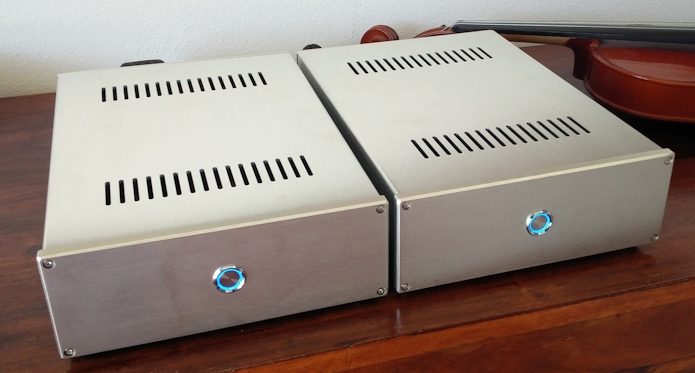
The incredibe ZeroZone IRS2092 power amps
The Nait XS reviewed on What HiFi
The Nait XS reviewed on Techradar
The Nait XS reviewed on 6moons
The ZeroZone IRS2092 reviewed on TNT-Audio
THE PAST
Unison Research Unico (2024-2025)
Naim Nait 5i (2019-2024)
Unison Research Mood (1991-2019)