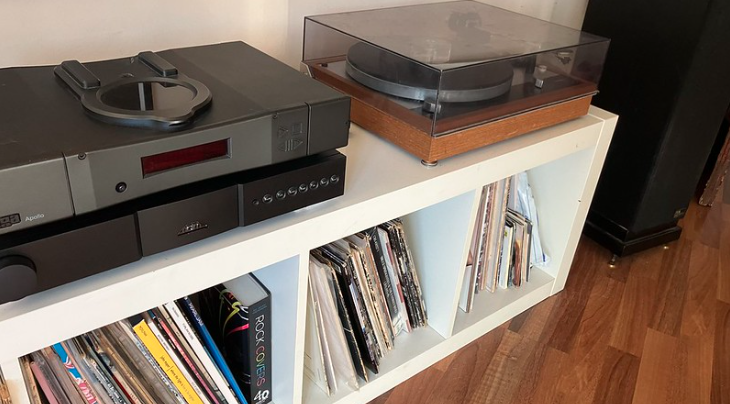
Today I can say I am completely satisfied with my system. Not that I hadn’t been before, but there had always been a bottleneck somewhere. It wasn’t just a feeling but an objective fact. At present, I believe that, apart from the age of some of the components, the system is balanced and sounds excellent. Of course, there’s always room for improvement, but at this stage it isn’t necessary because, in its current state and for its intended purpose, the system is excellent just as it is. The system centres on the TDL Studio 0.5 transmission line speakers. The speakers (together with the room) are the main factors determining a system’s sound. So it’s important to choose them carefully and know what you want to achieve. I knew this very well: back in 1991, I was convinced I wanted full-range speakers (not bookshelf speakers that cut off at 60 Hz – even though a musical signal rarely drops much lower than that). I wanted floorstanding speakers; after all, bookshelf speakers would have to be placed on stands, taking up exactly the same amount of space whilst being far less stable. The speakers shouldn’t have excelled in the bass whilst skimping on the rest of the spectrum. The TDLs were exceptional in the bass and excellent across the rest of the frequency range too. They were just right for me. Once the speakers were chosen, I then had to select an amplifier capable of driving them properly. But let’s analyse the specifications of my system component by component and see why, in any case, a further ‘upgrade’ – whilst technically possible – is not necessary.
I don’t have any modern components, apart from the DAC, which I believe is still in production. They range in age from the 1970s to the early 2000s. So there might be scope for an upgrade in terms of modernising the system. But let’s look at the sources first. I have two analogue sources and two digital ones. Starting with the analogue ones, here is the turntable: the legendary Thorens TD 160 MK1.

Analogue source: Thorens TD-160 turntable with Funk Firm Akromat and Grado 8MX cartridge
This is a suspension turntable, manufactured in Germany in the mid-1970s to be placed on standard furniture, taking into account its widespread use in homes with floating floors, which are therefore prone to vibration. The spring suspension system is designed to isolate the rotating platter from vibrations, mostly caused by people walking in the same room. The turntable is ‘stock’, apart from the connectors on the two stereo cables and the bituminous adhesive material added to the inside of the flimsy bottom panel. In the past, I have modified a few Thorens turntables by adding more damping material, modern cables and so on. However, I have done almost nothing to the one I still have. One small modification involved adding a ground cable – a change suggested by Thorens itself at the time. I had also completely replaced the RCA cables, but then I read that the originals had the correct capacitance for the turntable and, if in working order, could remain in place, so I refitted them. I replaced the original rubber record mat with an advanced, modern Funk Firm Akromat, made from PVC foam (PVC is vinyl, the same material as the records) with the aim of creating a single block with the record to dissipate vibrations over a larger volume.

Analogue source: Shure M97HE Era IV cartridge – in this case with a spare Nagaoka N97ED stylus
The most commonly used cartridge is the legendary Shure M97HE Era IV, which dates from the same period. Between the late 1970s and early 1980s, it was at the top of Shure’s price list, after the much-acclaimed V15 Era IV was dropped from the catalogue because it was too expensive to produce. Many argue that, despite the V15’s superior and distinctive technical specifications, the M97 sounded practically identical. Add to that the fact that a famous sound engineer once claimed he could not distinguish the sound of a Shure V15 on a standard Technics SL1200 from the original master, and you’ll understand why even here, considering an upgrade is no easy task. I could look at the modern market and perhaps go for an Audio-Technica AVM95ML. Or the excellent Grado cartridges. But I tried a recently produced Prestige Blue 3, which paled in comparison to its predecessors, the Signature 8MX and F-1+ (in fact, my setup consists of the body of the former and the stylus of the latter).
The Shure from the 1970s boasts remarkable technical sophistication and a ‘naked’ hyper-elliptical stylus – the sort of thing that costs a pretty penny these days. What’s more, Shure fitted the famous little brush that cleaned the groove just before the stylus passed over it. As well as doing that, it also dampens vibrations caused by records that aren’t quite ‘flat’ and stabilises the cartridge during playback. The presence of the lowered brush also ensures that the Shure, designed for lightweight tonearms with low tracking force, can also be adapted for medium-weight tonearms such as the Thorens. The original Shure N97 styluses also had an electrical connection to the tonearm to discharge static electricity. What more could you ask for? It’s hard to say. The only thing is that Shure stopped manufacturing cartridges some time ago, and replacement styluses are now made by third parties (and usually their brush doesn’t dissipate static electricity). But when the time comes, I know someone who’ll be able to restore my stylus to perfect condition.
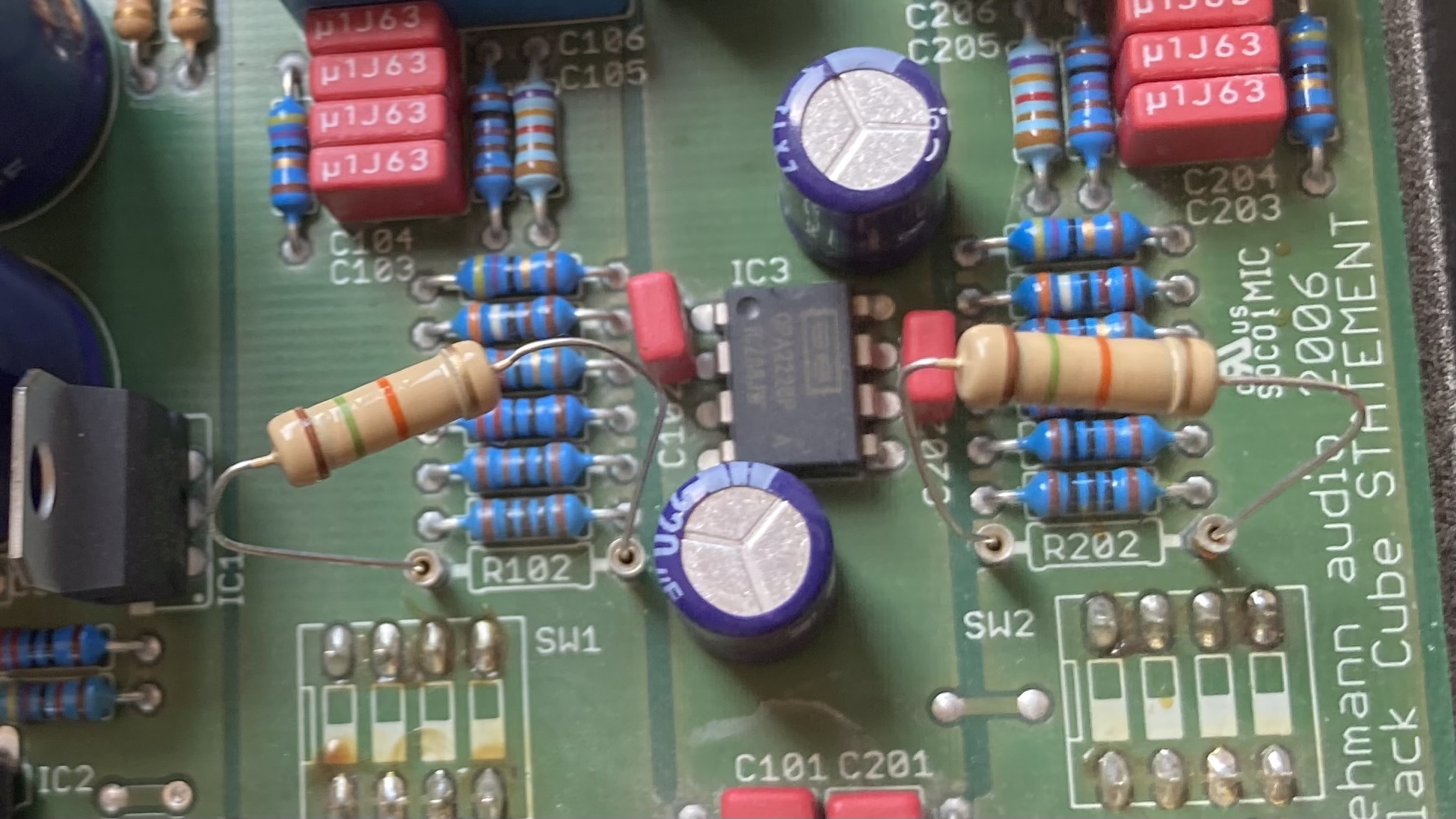
Analogue source: the interior of the Lehmann Black Cube Statement with two additional resistors, in an attempt to modify the load for the Grado F-1+ cartridge
The signal from the German turntable feeds into an excellent German phono pre-amplifier: the Lehmann Black Cube Statement. It is relatively modern and, although it has undergone some developments, it is certainly not a bottleneck in my system. It is now renowned for its quality and simplicity, combined with excellent build materials.
The other analogue source is of little importance. It’s a cassette recorder. Cassettes seem to have come back into fashion, but they’ve never really been hi-fi. I’ve owned several cassette recorders and was really into them. I must also say that recording a CD onto a chrome cassette with Dolby C engaged wasn’t that bad. I used it a lot back in the days when it wasn’t exactly cheap to buy records, and in any case, that was how you swapped music – by getting a friend who had a record you didn’t own to make a cassette for you. It was cheaper than buying the record or the CD. Try buying a new blank cassette now! The follies of vintage fashions…

Analogue source: Teac V1010 tape deck
I used to have a good Teac, but it had gone half-broken. I didn’t spend much to get hold of a very similar model, a V1010 from the 1990s. I don’t use it a lot, except to listen occasionally to old recordings from the 1980s with my band from back then, or to transfer audio from my computer – either my own recordings or tracks I’m streaming (which is a bit of a contradiction). To connect the Teac to my Naim Nait XS amplifier, I had to have a special cable made with two pairs of stereo RCA sockets on one end and a DIN connector on the other.
Let’s move on to digital sources. The vintage craze, which has driven up the prices of vinyl records to absurd levels, has prompted me to reconsider my CDs as well. So I made sure to get hold of a CD player that was a match for the standard of my system – something I’d rarely done in the past. The safest choice would have been a modern CD player: the reading mechanism is prone to problems due to age. It’s a real risk with older players. But modern CD players tend to sound …modern: lots of detail, emphasised treble, a very ‘clear’ sound that can perhaps be tiring on the ears. I went for the old-school approach and picked up a spectacular 2006 Rega Apollo.

Digital source: Rega Apollo CD player (2006)
Rega was famous for its turntables in the 1990s. The founder, Roy Gandy, had never heard a CD player that he liked. He thought they were awful and didn’t want anything to do with them. Then one of his collaborators managed to come up with a prototype built differently from the conventional models, which impressed even Roy! Over time, they decided to enter the CD market, and the first Rega models caused a sensation with their sound quality. I happened to come across the evolution of the first model, which featured a unique chip for digital-to-analogue conversion, far more powerful than the chips normally used in the audio sector at the time. It had been manufactured in England for a financial data processing project that subsequently failed, and the company sold off thousands of surplus chips to Rega, enabling the production of the Apollo and ensuring its continued maintenance to this day.
The Apollo features Wolfson DACs and separate Class A output stages. Its mechanism is superbly crafted yet original: rather than a carriage onto which you place the disc, which then closes to transport it to the reading mechanism. There’s a lid in the style of the Starship Enterprise from Star Trek; you open it and secure the CD in the reading mechanism by hand – fewer moving parts that can break and/or generate vibrations, decoupling, etc… here too, what more could you ask for? Perhaps a modern Rega Saturn – yes, that’s one thing – but the price is quite another, and the Apollo is certainly not a weak link in the chain!

Digital source: the Schiit Modius D/A converter
The other digital source is the computer. At the moment, it’s an old MacBook connected to the excellent Schiit Modius DAC. I use Tidal for streaming, but the app doesn’t run on the old Mac. So I use Audinirvana, an app that still runs on an old Mac and allows you to connect to your streaming accounts whilst keeping them isolated from the rest of the system for optimised playback. So much the better. It would be more convenient to use a modern streamer, but I’m not yet keen to invest any more in digital music. The DAC has been a real step up in quality and is the most modern component in the system. I’d read a lot of good things about it, then an opportunity came my way. It holds its own alongside the Rega, although you can hear the latter’s superiority even though it’s about fifteen years older. As usual, it’s a modern, detailed DAC, whilst the Rega has a more captivating sound – incredibly detailed yet never tiring. But the Schiit is perfectly adequate for streaming. The files available aren’t always up to scratch: not in terms of quality or resolution, but because on streaming platforms the files on offer are often those with a compressed dynamic range, as is currently the trend.
The amplifier is a British integrated amplifier, a Naim. Naim is the surname of Julian Vereker’s wife at the time he founded the company. In the 1960s, Julian had several friends in bands. He enjoyed recording them whilst they played, but then, back at home, when he listened to the recordings, he was disappointed by the lack of dynamics and engagement in the playback compared to what he heard live. So he decided to design a proper amplifier himself. This led to the creation of the first Naim Audio power amplifier, the NAP 1 (Naim Audio Power). He subsequently moved on to designing preamplifiers (Naim NAC) and, later, integrated amplifiers (Nait = Naim Audio Integrated Technology).
I have an excellent 2012 Naim Nait XS. It’s from the first XS series. I previously had a Nait 5i, which replaced the legendary Unison Research Mood. After my first Nait, I wanted to try a Unison Research Unico. It’s a very refined hybrid amplifier (valves in the preamp and MOSFETs in the power amp). In the end, I chose to stick with Naim, opting for the Nait XS (which is superior to the 5i). The Unico had some ventilation slots and, in my room, it would have ended up filled with dust. I didn’t have its remote control (which was damaged in transit), but it would only have been used to control the volume anyway. With the Naim, I can also change the source, and it’s completely enclosed, making it less at risk in my room.

Amplifier: Naim Nait XS (2012)
From a listening perspective, it wouldn’t be an easy choice. They are both excellent amplifiers. The Naim is more compelling due to its greater ease of maintenance and perhaps a touch more definition, linked above all to its famous qualities of rhythm and sense of timing (PRaT = Pace, Rhythm and Timing). The precision with which it is able to reproduce peaks where a lot of current is required is remarkable. I’ve read that soundstage isn’t Naim’s strong point by design: its strengths lie in engagement and dynamics. This makes the Rega CD player the perfect match. I had, of course, also considered Naim players, but they too are focused on engagement rather than three-dimensional imaging. The imaging from a Rega CD player, on the other hand, is fantastic, even though these too are focused on PRaT and an engaging musical reproduction. So the combination of a Rega player and a Naim amplifier is ideal!
Compared to the Nait 5i I had before, it seems far better able to drive the demanding load of my TDL Studio 0.5 speakers. The 5i also seemed more detailed and precise than the Unico, but the latter, being more powerful, seemed to drive the TDLs better in the lower end of the frequency spectrum. With the XS, this problem is sorted; it has plenty of current to spare, and things might improve somewhat with the addition of an external power supply such as the FlatCap or HiCap, though they say the improvement is minimal. So here too there’s little scope for upgrades unless you move up to the XS-2 or SuperNait. But I reckon it’s fine as it is…

Speakers: TDL Studio 0.5 from 1991 – low-frequency response extended down to 30 Hz!
And it was precisely the TDL Studio 0.5’s ability to reproduce low frequencies that made me so eager to have them in my system back in 1991. The Studio 0.5s have been a source of joy to me since December ’91, when they were driven by the Unison Research Mood, which I had to buy alongside them in order to drive them properly. TDL was a British brand which, drawing on the philosophy that had made the IMF’s incredible bass so famous, utilised a transmission line to drive the woofers. More commonly, the system used for this purpose is the bass reflex: a suitably sized pipe directs the rear emission of the woofer into the cabinet so as to generate bass reinforcement at a certain frequency. However, the presence of an opening in the cabinet compromises the woofer’s damping compared to a sealed cabinet. This is not the case with the transmission line, which instead utilises a specially designed and insulated internal labyrinth. The quality of the bass damping is comparable to that of a sealed enclosure, but the low frequencies it is capable of reproducing would have required an enormous sealed enclosure (at least in those days). The result is a relatively small enclosure that sounds as though it were enormous: any competitor in that price range – and even higher – could completely forget about achieving such performance at low frequencies.
The point of reproducing the full frequency spectrum isn’t to obtain an excellent response at 30 Hz – musical signals rarely drop below 60 Hz – but rather that a small car can easily reach 130 km/h on the motorway, and that’s as fast as it can go; but how does that compare to the way a large saloon car gets there?
 |
 |
Before: the Elac 6DC 363 woofer, with its original ogive-shaped dust cap, which is damaged and no longer in production |
After: the same woofer but with the new dome dust cap, skilfully re-edged and repaired by Riparazione Altoparlanti Roma, which required the dust cap to be replaced |
After so many years, my beloved TDLs are still going strong. Unfortunately, I recently had to have the woofer suspensions replaced. This also meant replacing the central protective dome on the woofer, which also serves to guide the sound wave forwards. On the Studio 0.5 models, the domes were ogival in shape and were not readily available. I had to accept having standard round domes fitted. Moreover, the material of the new suspension couldn’t be identical to the original either, but replacing the drivers with equivalents (Elac woofers haven’t been manufactured for years) would have completely distorted the original design (the crossover – the internal circuit that distributes low and high frequencies between the woofer and tweeter – is designed for very specific driver characteristics, and there are no truly equivalent drivers). With the woofer surrounds damaged, the TDLs hadn’t sounded the same for quite some time. Having the original woofers repaired has restored them to a fantastic sound!
It’s likely that, with modern technology and, above all, materials, today’s speakers could replace my TDLs – perhaps even improving the sound quality of my system; nowadays there are standard-sized sealed-box speakers with similar bass performance on paper; I’m not sure if that applies to the quality as well. And I’m told that once you’ve heard the bass from a transmission line, you can’t do without it…